
West Papua & Raja Ampat Birding Trip 21D20N
Tour Overview
This comprehensive itinerary explores lowland rainforests, swamp forests, foothills, and montane habitats, targeting iconic Papuan endemics such as Wilson’s Bird-of-paradise, Red Bird-of-paradise, Lesser Bird-of-paradise, Magnificent Riflebird, King Bird-of-paradise, Twelve-wired Bird-of-paradise, and Western Parotia, alongside a dazzling diversity of parrots and kingfishers including Palm Cockatoo, Pesquet’s Parrot, Eclectus Parrot, Hook-billed Kingfisher, and Blue-black Kingfisher.
Located within the Australasian biogeographical realm, West Papua represents the easternmost frontier of Indonesia’s avian diversity, where ancient forests harbor an exceptional concentration of endemic species. The journey spans a wide range of ecosystems—from humid lowland jungles and riverine forests to cool, misty mountain slopes—allowing encounters with forest gems such as Crowned Pigeon, Papuan Pitta, Greater Lophorina, and numerous honeyeaters and fruit doves. Combined with remote landscapes and rich indigenous cultures, this extended West Papua birding tour offers one of the most rewarding birdwatching experiences in the world.


Other Trips
Sumatra & Java Birding Expedition 17D16N
Explore the diverse birdlife of Sumatra and Java on a 17-day birding expedition
Sulawesi-Halmahera Birding 16D15N
Sulawesi–Halmahera birding offers a spectacular exploration of Wallacea’s most biologically distinctive islands
Lesser Sunda Birding 18D17N
Lesser Sunda birding is an extraordinary journey through one of Indonesia’s most important centers of island endemism, explored in depth
North Maluku – Obi Island Birding 6D5N
Obi Island birding in North Maluku is a true expedition-style experience for adventurous birders exploring the legendary Land of Spices
North Maluku – Morotai Birding 5D4N
Birding in Morotai, North Maluku, offers an excellent introduction to the unique avifauna of the northern Moluccas.
Halmahera Birding Trip 7D6N
This Halmahera birding tour combines world-class endemic birds, raw island landscapes, and genuine field experiences
West Papua & Raja Ampat Birding Trip
21 Days / 20 Nights
Day 1: Arrival in Biak
Arrive in Biak, West Papua, where the birding adventure begins. Transfer to the accommodation and settle in for the night. Overnight in Biak.
Days 2–3: Birding on Biak Island
We have two full days to explore Biak and search for its remarkable collection of endemic and specialty birds. Many of these species can still be found in good secondary forest and selectively logged areas. Biak supports a fascinating mixture of species, including birds that occur more widely across the islands of Geelvink Bay as well as species restricted to Biak, neighbouring Supiori, and the surrounding islands.
Our main focus will be on the island’s endemic birds, including the endemic Biak Paradise Kingfisher, which remains relatively common and is often conspicuous. In more open habitats, we will look for Yellow-bibbed Fruit Dove, Claret-breasted Fruit Dove, and Geelvink Imperial Pigeon, all of which can be vocal and frequently perch in exposed positions.
Secondary growth provides suitable habitat for the endemic Biak White-eye, while Biak Red Lories may be seen rapidly passing overhead. The forest holds many of the island’s other endemic species and specialties, including the common Long-tailed Starling. Nights in Biak.
Day 4: Biak to Wamena
This morning we fly to Sentani and then continue with a short but spectacular flight to Wamena in the Grand Baliem Valley. The remainder of the day will be spent exploring the area around Wamena.
In the cultivated landscapes near town, we will look for Ornate Melidectes, Black-breasted Munia, and the striking Superb Bird-of-Paradise, which can occur surprisingly close to villages. We will also search for the giulianettii Island Leaf Warbler, regarded as a potential future split, as well as the Baliem Whistler, which is already recognised as a full species.
Overnight in Wamena.
Days 5–6: Wamena and the Snow Mountains
Wamena will serve as our base as we make daily excursions by 4WD into the spectacular Snow Mountains, particularly around the Grand Baliem Valley. The route follows winding roads through beautiful forest, with regular birding stops along the way. During our stay, we will explore several different habitats in search of the region’s special birds.
At the high-altitude grasslands around Lake Habbema, we will bird beneath the impressive backdrop of Mount Trikora (4,700 m). One of the principal targets here is the striking MacGregor’s Honeyeater. Although this species can be shy, its presence is often revealed by loud whooshing sounds as birds fly along the hillsides, with their orange primary patches clearly visible. DNA research has demonstrated that this remarkable species is actually a honeyeater rather than a bird-of-paradise, although it remains one of the area’s most unusual birds.
Other species we may encounter include Snow Mountain Quail, often flushed from the grasslands, together with Western Alpine Mannikin, Mountain Firetail, Alpine Pipit, and Papuan Harrier, particularly in more open habitats.
The alpine shrublands support Sooty Melidectes, Short-bearded Melidectes, Orange-cheeked Honeyeater, and Lorentz’s Whistler. The lake and its surrounding fringes are home to several pairs of Salvadori’s Teal and Spotless Crake. As evening approaches, we will hope to encounter New Guinea Woodcock and the little-known Archbold’s Nightjar.
Although we will keep steep and demanding trails to a minimum, we will also explore some of the upper mossy forests, where an entirely different collection of birds can be found. Ground-dwelling species include Chestnut Forest Rail, New Guinea Logrunner, and the shy red-eyed Lesser Melampitta. With some luck, we may also encounter the rare Greater Ground Robin in the tree-line forest above the elevation where the more common Lesser Ground Robin occurs.
Additional possibilities include Splendid Astrapia, Brown Sicklebill, Black Sittella, Crested Berrypecker, Rufous-naped Bellbird, Papuan Treecreeper, Rufous-throated Bronze Cuckoo, Brehm’s Tiger Parrot, Modest Tiger Parrot, and the beautiful Plum-faced Lorikeet, among many others.
Nights in Wamena.
Day 7: Wamena to Nimbokrang
This morning we fly back to Sentani before continuing into the lowland forests of Nimbokrang, situated at the foot of the imposing Cyclops Mountains. We will spend the next three nights at a basic homestay.
The remainder of the day will be dedicated to exploring this exceptionally bird-rich area.
Days 8–9: Birding Nimbokrang
Nimbokrang’s flat alluvial rainforest has experienced logging, but substantial areas of good secondary and selectively logged forest remain. Birding here can be challenging, but the potential rewards are considerable.
Several species of Bird-of-Paradise occur in the area. Our principal targets will include Pale-billed Sicklebill, along with the spectacular displays of Twelve-wired Bird-of-Paradise and King Bird-of-Paradise.
The area’s long list of potential species also includes several important specialties. We will search for Salvadori’s Fig-Parrot, Brown Lory, Western Black-capped Lory, Lowland Peltops, Buff-faced Pygmy Parrot, Blue Jewel Babbler, White-eared Catbird, Brown-headed Crow, and Jobi Manucode.
Nights at the basic homestay in Nimbokrang.
Day 10: Nimbokrang to Sentani
After a final morning of birding in the tropical lowland forests around Nimbokrang, we return to Sentani for an overnight stay.
Day 11: Sentani to the Arfak Mountains
We begin the day exploring the grasslands near Sentani, beneath the Cyclops Mountains. This area can produce Fawn-breasted Bowerbird, Grand Mannikin, and Hooded Mannikin.
We then fly to Manokwari, on the western shore of Geelvink Bay. From Manokwari, we travel by road into the Arfak Mountains, reaching our host village at approximately 1,600 metres.
During our stay in the Arfaks, we will use a basic but comfortable guesthouse as our base. Birding will focus on the easier trails as well as productive roadside areas.
Days 12–14: Birding the Arfak Mountains
The remote Arfak Mountains are home to an impressive range of montane birds, including some of New Guinea’s most sought-after and least-known species.
A major highlight is the opportunity to visit a Western Parotia dancing ground. Specially constructed hides overlook some of these display sites, allowing us the possibility of watching the extraordinary male birds perform their famous “ballerina dance” at extremely close range. Magnificent Bird-of-Paradise can also be observed at their display areas.
Other highly desirable species we will search for include the elusive Black-billed Sicklebill, the little-known Long-tailed Paradigalla, and the fascinating Vogelkop Bowerbird. This species constructs an impressive bower and is also an accomplished mimic, capable of imitating the songs of other birds.
Our local Papuan guides are highly skilled at locating these difficult species and may also provide daytime encounters with the unusual-looking Feline Owlet-nightjar and Mountain Owlet-nightjar.
At higher elevations, roadside birding can produce Black Sicklebill, Orange-crowned Fairy-wren, Western Smoky Honeyeater, Vogelkop Melidectes, and, with luck, the rare Arfak Astrapia.
Day 15: Arfak Mountains to Manokwari
Following our final day of birding in the Arfak Mountains, we return to Manokwari. This evening provides an opportunity to enjoy a welcome hot shower and relax after our time in the mountains.
Overnight in Manokwari.
Day 16: Manokwari to Sorong
Today we fly to Sorong. If our arrival time allows, we will explore areas around the city in search of local specialties including Blue-black Kingfisher and Black Thicket-Fantail.
Overnight in Sorong.
Day 17: Sorong to Waigeo
We will use any available time to bird the forests outside Sorong, with opportunities for localized and less frequently encountered species such as Black Lory and Red-breasted Paradise Kingfisher.
Later, we take the fast ferry to Waisai on Waigeo, where we will stay for three nights.
Days 18–19: Birding Waigeo, Raja Ampat
Waigeo supports several species that do not occur on the mainland, and these island specialties will be the main focus of our time here.
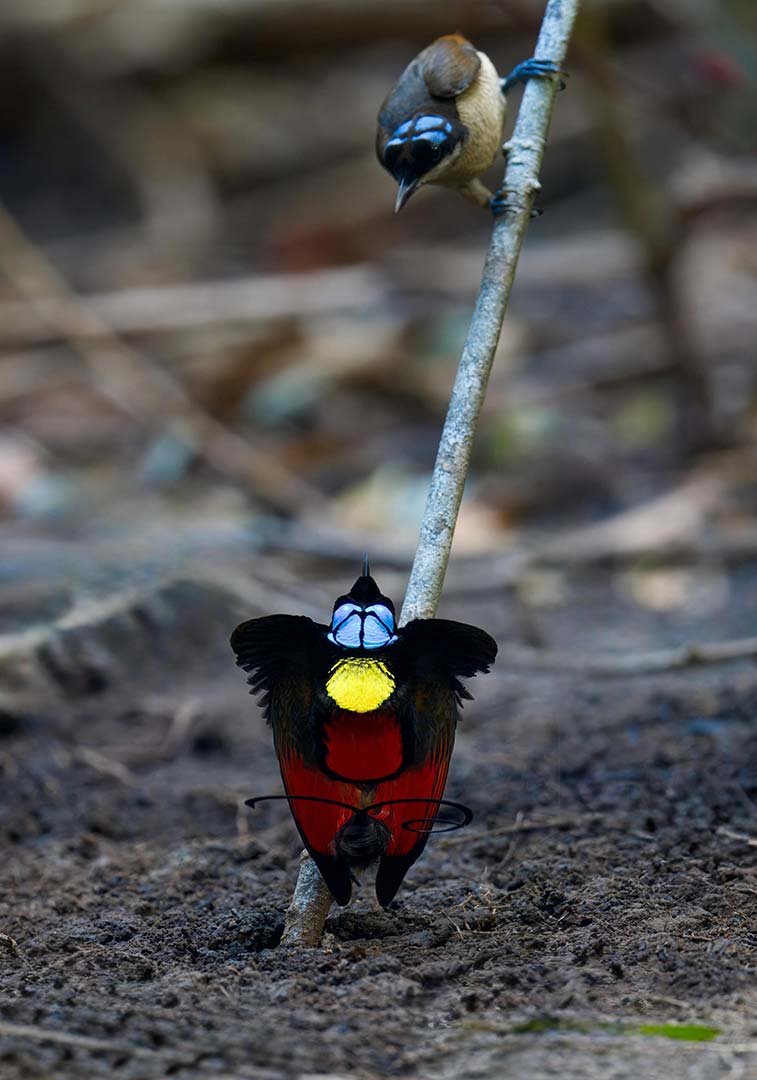
Our principal target is the spectacular Wilson’s Bird-of-Paradise, a species frequently regarded as one of the world’s most beautiful birds. Specially constructed hides provide opportunities to observe these birds at their display grounds while they remain seemingly unaware of our presence.
With good fortune, we may watch a male actively displaying, calling and performing its elaborate courtship display when females enter the display arena.
Other birds we will search for on Waigeo include Red Bird-of-Paradise, which is restricted to Waigeo and Batanta, together with Raja Ampat Pitohui and the shy Western Crowned Pigeon.
Nights in Waisai.
Day 20: Waigeo to Sorong
After a final morning of birding on Waigeo, we return by boat to Sorong for our final overnight stay.
Overnight in Sorong.
Day 21: Departure from Sorong
The West Papua & Raja Ampat Birding Trip concludes this morning with departures from Sorong.